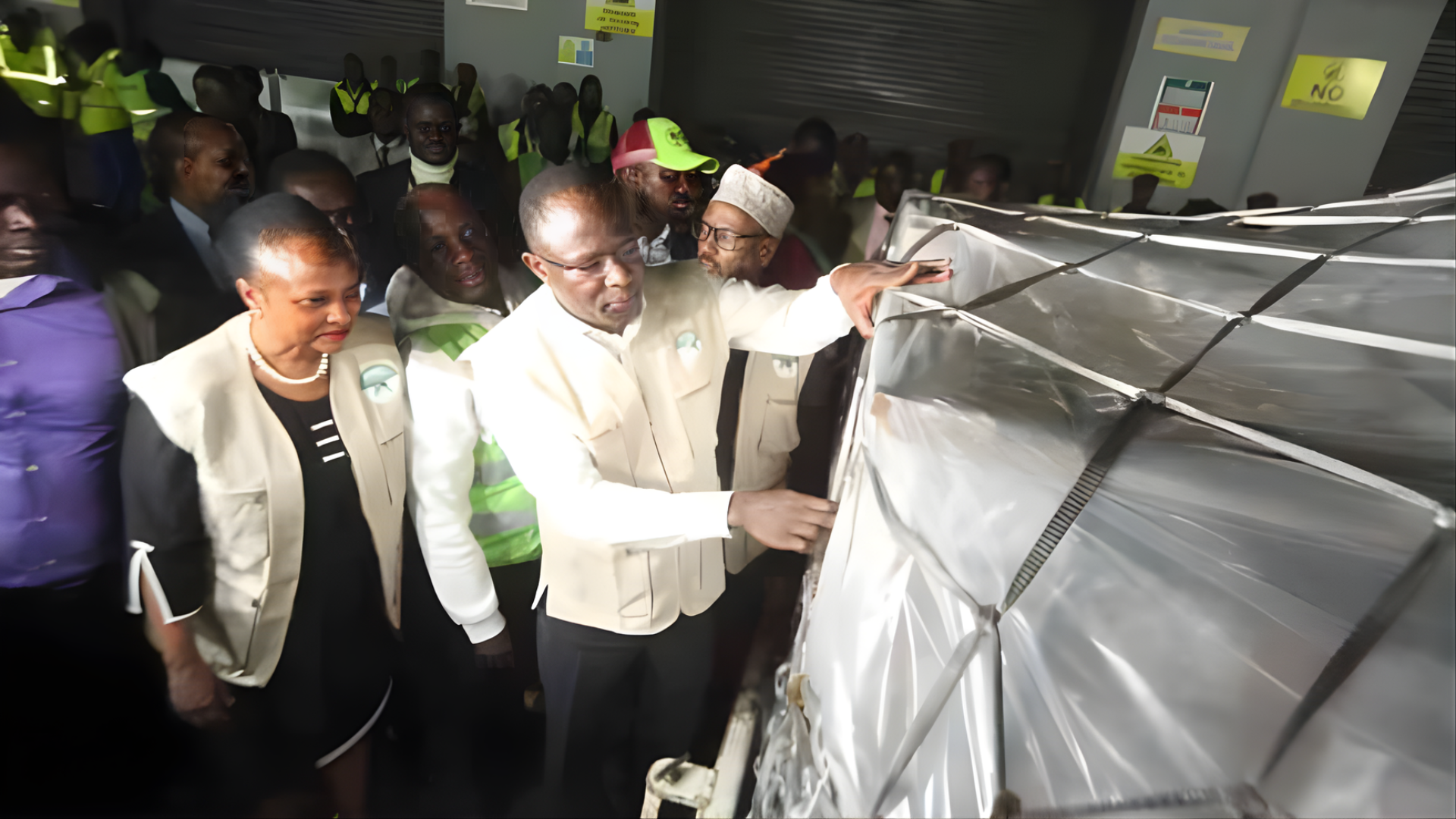
The cavernous cargo terminal at Jomo Kenyatta International Airport hummed with unusual tension on the night of Wednesday, November 19, 2025, as a chartered Emirates SkyCargo flight from Athens touched down just after 11 p.m., its belly carrying the first ten pallets of freshly printed ballot papers for the upcoming by-elections. Under the glare of floodlights and the watchful eyes of armed General Service Unit officers and IEBC security personnel, the pallets—each wrapped in tamper-evident plastic and bearing serialised seals—were offloaded, scanned, and transferred to a convoy of Kenya Police trucks for the short, heavily escorted journey to the commission’s warehouse at the Anniversary Towers in Nairobi. By dawn on Thursday, IEBC Chairperson Wafula Chebukati was on site to personally inspect the consignment, running his finger along the crisp edges of a sample ballot for Banisa Constituency as he addressed a small group of journalists and party agents. "These are the voices of the people, printed with the highest security features available anywhere in the world—watermarks, micro-text, heat-sensitive ink, serial numbering. We have received the first ten pallets tonight; the remaining twenty-nine will arrive by Friday evening," Chebukati announced, his voice calm but firm against the clatter of forklifts in the background. "Printing cost us twenty-seven million shillings in Greece, but the price of a free and fair election is priceless. Distribution to the seven constituencies and five wards begins this Friday, November 21."
The by-elections, scheduled for Thursday, November 27, will fill vacancies in Banisa, Kasipul, Kitui South, Ugunja, Mbeere North, Kabondo Kasipul, and Kisauni constituencies, alongside five wards—Kholera in Banisa, Central Kamagambo in Kasipul, Kwa Njenga in Embakasi South, Shella in Lamu, and Woodley/Kenyatta Golf Course in Kibra. The vacancies arose from a mixture of deaths, resignations, and court nullifications, with the most politically charged contest in Banisa Constituency in Mandera County, where the April 2025 killing of incumbent MP Kullow Maalim Hassan in a suspected clan-related attack left the seat vacant and tensions simmering. It is precisely these security concerns that have prompted the commission to deviate from standard road transport for the first time in a by-election. "For Banisa, Mandera Town, and Lafey wards, we are using air transport—Kenya Defence Forces helicopters will fly the materials directly to the constituency tallying centres on Saturday morning," Chebukati confirmed, revealing that the Ministry of Defence had already allocated two Mi-17 helicopters and one C-27 Spartan for the operation. "We are not taking chances with road ambushes or ballot snatching. The same aircraft will bring back the sealed boxes on polling night."
The decision to print in Greece rather than locally—a departure from the 2022 general election when Inform Lykos in Nairobi handled the job—stems from both cost and security considerations. The Greek printer, known for supplying elections in Cyprus, Albania, and recently war-torn Sudan, offered a 22 percent lower quote and guaranteed delivery within fourteen days before polling day, compared to local printers’ twenty-one-day timelines. "We subjected five international firms to rigorous technical and financial evaluation," IEBC Director of Procurement Roseline Odede explained at the warehouse, pointing to pallets stacked high with boxes labelled in both English and Greek. "Greece won fairly. Every ballot has a unique QR code that returning officers will scan to verify authenticity on polling day. Any fake will be rejected instantly by the KIEMS kit." Party agents from UDA, Azimio, and smaller outfits milled around taking photographs, with UDA’s national elections board member Mohammed Ali nodding approvingly. "The seals are intact, the serial numbers sequential—I am satisfied," Ali said, though he quickly added, "but we will still station agents at every stage of distribution."
Distribution logistics are already in high gear. On Friday morning, November 21, the first road convoys will leave Nairobi for the relatively secure constituencies—Kisauni, Kitui South, Mbeere North, and the Nairobi ward of Woodley/Kenyatta Golf Course—under police escort. Saturday will see the airlift to Mandera, while Kasipul, Kabondo Kasipul, and Ugunja in the Nyanza region will receive theirs by road escorted trucks departing Kisumu on Sunday. Each constituency will receive its full consignment in a single delivery to avoid the confusion that marred the 2017 Garissa Township by-election when ballots arrived in stages. "We have learned from the past," Chebukati said, recalling the Supreme Court’s 2017 annulment that cited logistical failures. "One constituency, one delivery, one seal, one verification. No room for human error or malice."
Security remains the dominant concern in Mandera, where clan rivalries and Al-Shabaab threats have historically disrupted voting. The National Police Service has deployed an additional 2,000 officers to the county, with Rapid Deployment Unit teams prepositioned along the Somalia border. "We are treating Banisa like a general election hotspot," Regional Police Commander Noah Mwivanda told journalists at a Mandera briefing on Thursday. "Helicopters will land inside the DC’s compound; materials will move only fifty metres to the tallying hall. No vehicle movements after 4 p.m. on polling day." Local leaders welcomed the airlift. "Last time, ballot boxes were delayed two days on the road—people almost rioted," said Banisa Ward Rep Adan Barrow. "This time, we want the vote to speak before the gunshots do."
Voter education teams have fanned out across the twelve polling areas. In Kisauni’s Bamburi ward, where a court nullified the 2022 election over voter bribery, community mobiliser Amina Juma was addressing a group of 200 women under a mango tree on Thursday afternoon. "Come out on the 27th—your vote is secret, your ballot is safe, and now even the journey of the paper is safe," she urged, holding up a sample ballot that drew murmurs of approval. In Kitui South, where the seat fell vacant after Rachel Nyamai’s appointment as CAS, youth leader Mutuku Kyalo reported turnout rehearsals exceeding 1,000 per session. "People are hungry for change—they just want to be sure the vote will count," he said.
The commission has also introduced real-time tracking for the first time. Every sealed ballot box will carry a GPS-enabled tag visible to party agents and observers via a secure IEBC portal. "From the moment the helicopter lifts off Mandera airstrip on Thursday night until it lands back in Nairobi, everyone will know exactly where their democracy is," Chebukati promised, tapping a tablet displaying a live map of the planned routes.
As the remaining twenty-nine pallets wing their way across the Mediterranean, the country holds its breath for what many see as a mini-referendum on the Ruto administration’s three years in power. In Banisa’s dusty streets, elders gathered under acacia trees on Thursday evening spoke of peace but also of vigilance. "Let the ballots come by air, by road, by camel if needed," said 72-year-old Hassan Dagane, a former councillor. "Just let them come intact, and let our choice be respected."
Friday’s distribution convoys will roll out at 5 a.m. sharp. The helicopters will spin up at Wilson Airport on Saturday dawn. And on November 27, twelve constituencies and wards will speak. For now, ten pallets sit quietly in a Nairobi warehouse—silent, sealed, and waiting to become the voice of a nation.
The pallets: 10 arrived Wednesday night, 29 more by Friday. Cost: Sh27 million Greece. Airlift: Banisa, Mandera Town, Lafey. Road: Kisauni, Kitui South, Mbeere North, Woodley. Helicopters: two Mi-17, one C-27 Spartan. GPS tags: real-time tracking portal. Juma’s mango tree: 200 women. Kyalo’s rehearsals: 1,000 youth. Dagane’s camel: intact choice. In Kenya’s vigilant vote, the ballots begin—a Greek-printed promise where security safeguards sovereignty, and democracy descends delivered.