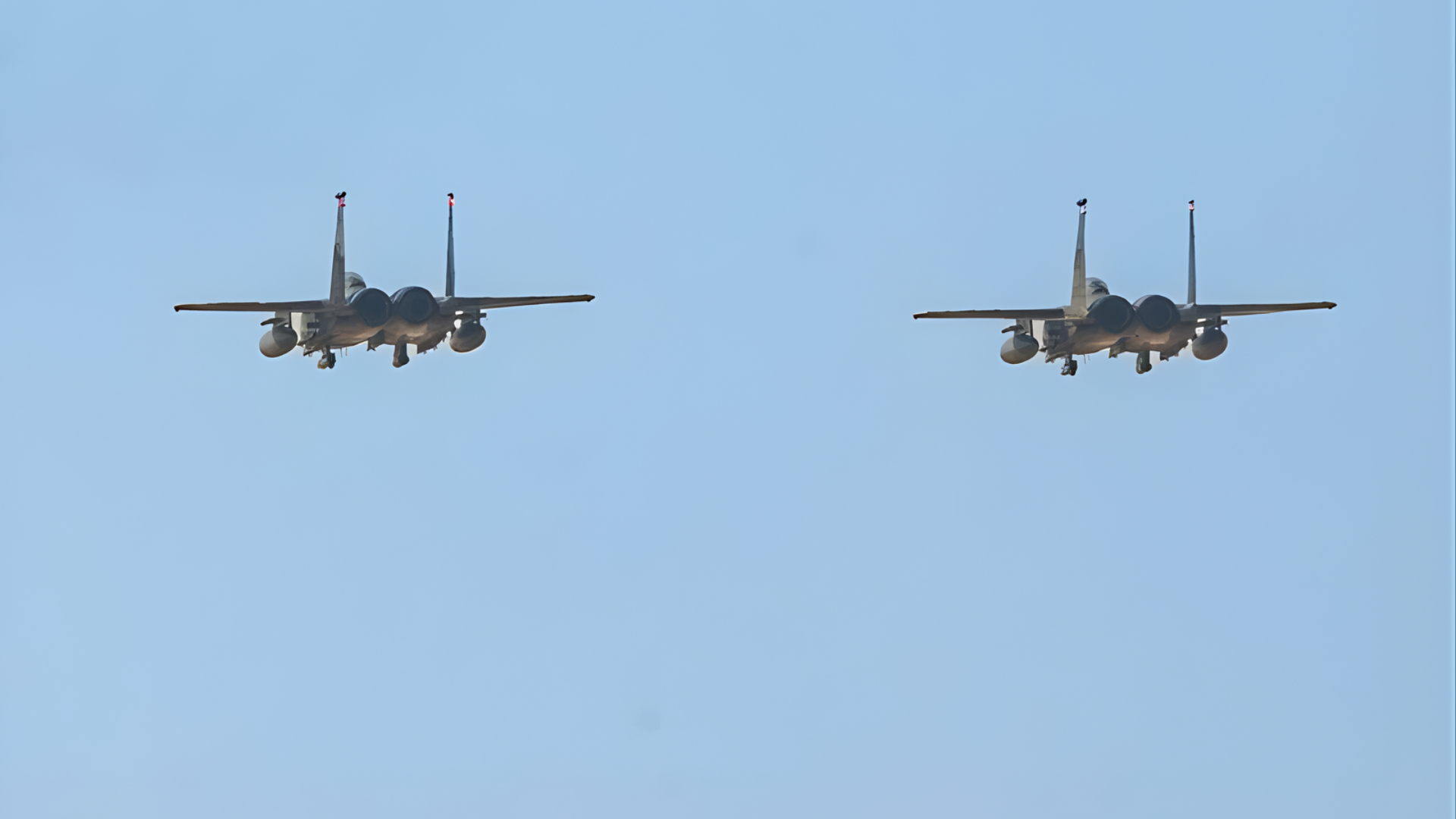
Three U.S. Air Force F-15E Strike Eagles were accidentally shot down by Kuwaiti air-defense systems in a friendly-fire incident that occurred around 11:03 p.m. Eastern Time on March 1, 2026, during Operation Epic Fury, U.S. Central Command confirmed early Sunday.
The multi-role fighter-bombers were part of a large formation conducting routine combat air patrols and suppression-of-enemy-air-defenses missions over northern Kuwait and southern Iraq when the engagement took place. According to CENTCOM’s initial readout, the Kuwaiti Air Force’s integrated air-defense network misidentified the American aircraft as hostile threats—likely due to a combination of procedural error, IFF (Identification Friend or Foe) transponder malfunction or interpretation failure, and heightened alert status triggered by recent Iranian missile and drone activity in the region.
All six crew members—three pilots and three weapon systems officers—successfully ejected from their aircraft. Parachutes were observed deploying over a semi-urban area near the Kuwait–Iraq border. Videos that appeared online within an hour of the incident showed three separate ejection sequences: two pilots coming down close to a residential neighborhood and one near a major highway. In each case, local Kuwaiti civilians rushed to the landing sites, helped the airmen release from their harnesses, provided initial first aid and loaded them into private SUVs and pickup trucks to transport them to waiting ambulances.
U.S. Central Command praised the rapid response by Kuwaiti military and civilian personnel. “Kuwaiti armed forces and ordinary citizens acted swiftly and professionally to locate and secure our aircrew,” a CENTCOM spokesperson said in a follow-up statement. “All six aviators were recovered in stable condition and are receiving medical evaluation. We are deeply grateful for the immediate assistance provided by our Kuwaiti partners.”
The three aircraft were destroyed on impact, with burning wreckage scattered across several kilometers of open desert and sparsely populated farmland. No civilian injuries or fatalities have been reported on the ground, although several homes sustained minor shrapnel and blast damage. Kuwaiti authorities quickly cordoned off the crash sites and began recovery operations under joint U.S.–Kuwaiti supervision.
Operation Epic Fury, launched in late January 2026, is a U.S.-led coalition effort involving air, naval and special-operations assets from multiple nations aimed at deterring and degrading Iranian threats—including long-range ballistic missiles, cruise missiles, one-way attack drones and proxy militia activity targeting U.S. and partner forces across the Middle East. The operation has seen frequent defensive intercepts of Iranian-origin projectiles fired from Iraq, Syria and Yemen, placing air-defense networks in the Gulf under constant high alert.
Military analysts said the friendly-fire incident, while tragic, is not unprecedented in high-threat environments where multiple coalition air forces operate simultaneously with different IFF protocols and radar systems. “The margin for error shrinks dramatically when you have layered air-defense networks, fast-moving aircraft and near-continuous missile threats,” said a retired U.S. Air Force fighter pilot familiar with Gulf operations. “Misidentification can happen in seconds. The important thing is that all crew ejected successfully and were recovered quickly.”
U.S. defense officials have already initiated a joint investigation with Kuwaiti counterparts to determine the exact sequence of events. The probe will examine radar tracks, IFF interrogation logs, voice communications, aircraft transponder status and the rules-of-engagement posture at the time of the shoot-down. CENTCOM has temporarily adjusted patrol patterns and increased deconfliction measures with Kuwaiti forces while the review continues.
The incident has renewed debate about the risks of prolonged high-intensity air operations in a crowded airspace. Several U.S. lawmakers called for a classified briefing on Epic Fury’s risk-mitigation protocols. “Friendly fire is always heartbreaking, but when it happens in an allied country during a defensive mission, we need to understand exactly what failed,” said one member of the House Armed Services Committee.
Kuwaiti officials expressed regret and reaffirmed their commitment to the coalition. “Our air-defense operators were acting to protect Kuwaiti airspace and coalition partners,” a Kuwaiti Ministry of Defense spokesperson said. “This tragic mistake will be thoroughly investigated. We extend our deepest apologies to the United States and to the families of the aircrew.”
All six airmen are receiving treatment at a U.S. military medical facility in the region. Initial assessments indicate non-life-threatening injuries, primarily related to ejection forces and minor impact trauma during landing.
The loss of three F-15E Strike Eagles represents a significant material blow to U.S. Central Command’s strike capability in the theater, although officials insist replacement airframes are already being positioned and operational tempo will not be materially affected in the short term.
As the investigation proceeds, the incident underscores the razor-thin margins that coalition air forces navigate daily while deterring Iranian aggression across a volatile arc from Yemen to Iraq.