 Faith Masita
A major tax evasion and smuggling investigation is unfolding in Kenya, placing senior officials from the Kenya Revenue Authority under scrutiny alongside a Kenyan–US dual citizen accused of orchestrating a sophisticated contraband network.
Detectives, with support from Interpol, are probing what is believed to be a well-coordinated operation exploiting systemic weaknesses in customs enforcement and cross-border trade systems.
Alleged Mastermind and Inner Circle
At the center of the investigation is Peter Mwaniki Maina, a dual citizen now on the radar of law enforcement agencies. Authorities allege he operated a complex smuggling ring with both local and international connections.
Alleged Mastermind and Inner Circle
At the center of the investigation is Peter Mwaniki Maina, a dual citizen now on the radar of law enforcement agencies. Authorities allege he operated a complex smuggling ring with both local and international connections.
His associate, Stacy Wangari Njiri, is believed to have managed local operations. Investigators suspect she coordinated logistics, storage, and distribution of goods from a residence along Kiambu Road—reportedly acquired by Maina. The duo is also said to have promoted a logistics firm, Arisilva Logistics, on social media platforms—presenting a legitimate front for what authorities believe were illicit operations.
How the Scheme Allegedly Worked
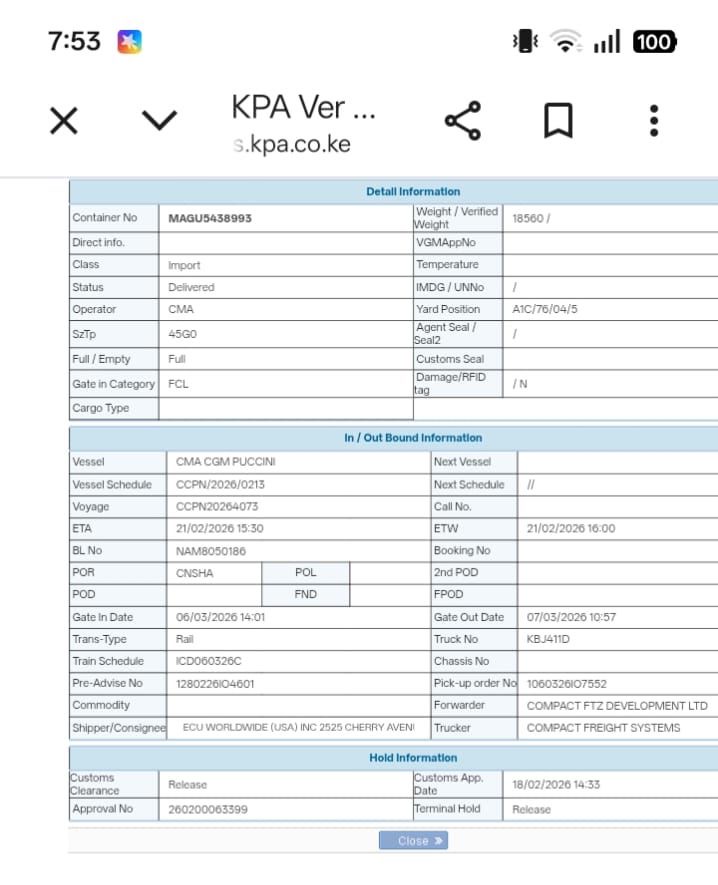
Investigations point to a suspicious shipment—container number MAGU5438993—cleared through the Compact Special Economic Zone (SEZ) in Nairobi under questionable circumstances. The clearance process allegedly involved collusion with insiders within KRA’s verification department, raising serious concerns about internal oversight and procedural integrity.
Investigations point to a suspicious shipment—container number MAGU5438993—cleared through the Compact Special Economic Zone (SEZ) in Nairobi under questionable circumstances. The clearance process allegedly involved collusion with insiders within KRA’s verification department, raising serious concerns about internal oversight and procedural integrity.
In a critical breakthrough, whistleblowers within KRA reportedly flagged the irregularities to senior leadership. Enforcement teams acted swiftly, tracing and seizing the container at Viken Thirty Industrial Park in Kamakis, Nairobi.
Authorities describe the interception as a “near miss,” preventing what could have been a large-scale infiltration of contraband into the local market.
Undeclared Goods and Wider Risks
Preliminary findings indicate the shipment—valued at millions of shillings—contained undeclared goods. Investigators are also examining the possibility that it included counterfeit items and potentially illicit substances, elevating the case beyond tax evasion to a matter of public health and national security.
A Pattern of Systemic Vulnerabilities
The case highlights ongoing challenges within Kenya’s trade and border control systems. The Kenya Ports Authority, particularly operations at the Port of Mombasa, has long been identified as vulnerable to smuggling despite recent reforms.
Authorities describe the interception as a “near miss,” preventing what could have been a large-scale infiltration of contraband into the local market.
Undeclared Goods and Wider Risks
Preliminary findings indicate the shipment—valued at millions of shillings—contained undeclared goods. Investigators are also examining the possibility that it included counterfeit items and potentially illicit substances, elevating the case beyond tax evasion to a matter of public health and national security.
A Pattern of Systemic Vulnerabilities
The case highlights ongoing challenges within Kenya’s trade and border control systems. The Kenya Ports Authority, particularly operations at the Port of Mombasa, has long been identified as vulnerable to smuggling despite recent reforms.
Authorities have previously intercepted a range of illegal imports, including counterfeit electronics, undeclared luxury goods, restricted pharmaceuticals, narcotics, and vehicles fraudulently cleared under the “returning residents” scheme. Experts warn that such networks often exploit tax exemptions, forged documentation, and insider collusion to bypass customs controls.
A Potential Transnational Syndicate
Investigators now believe the operation could be part of a broader multinational smuggling network with links to international supply chains. The involvement of Interpol signals the scale and seriousness of the case, with the possibility of cross-border arrests, asset tracing, and extradition proceedings.
If the allegations are proven, those involved could face severe charges, including tax fraud, organized crime, and trafficking of illegal goods—offenses that carry significant legal consequences both locally and internationally.
Investigators now believe the operation could be part of a broader multinational smuggling network with links to international supply chains. The involvement of Interpol signals the scale and seriousness of the case, with the possibility of cross-border arrests, asset tracing, and extradition proceedings.
If the allegations are proven, those involved could face severe charges, including tax fraud, organized crime, and trafficking of illegal goods—offenses that carry significant legal consequences both locally and internationally.
The Bigger Picture
As investigations continue, the case is expected to test the robustness of Kenya’s customs enforcement systems and could expose deeper institutional vulnerabilities.
It also underscores the growing complexity of transnational financial crime—and the urgent need for tighter controls, transparency, and accountability within critical state agencies.
It also underscores the growing complexity of transnational financial crime—and the urgent need for tighter controls, transparency, and accountability within critical state agencies.